
Call for Articles: Compendium No. 8
Deadline for submissions: 16 June 2025
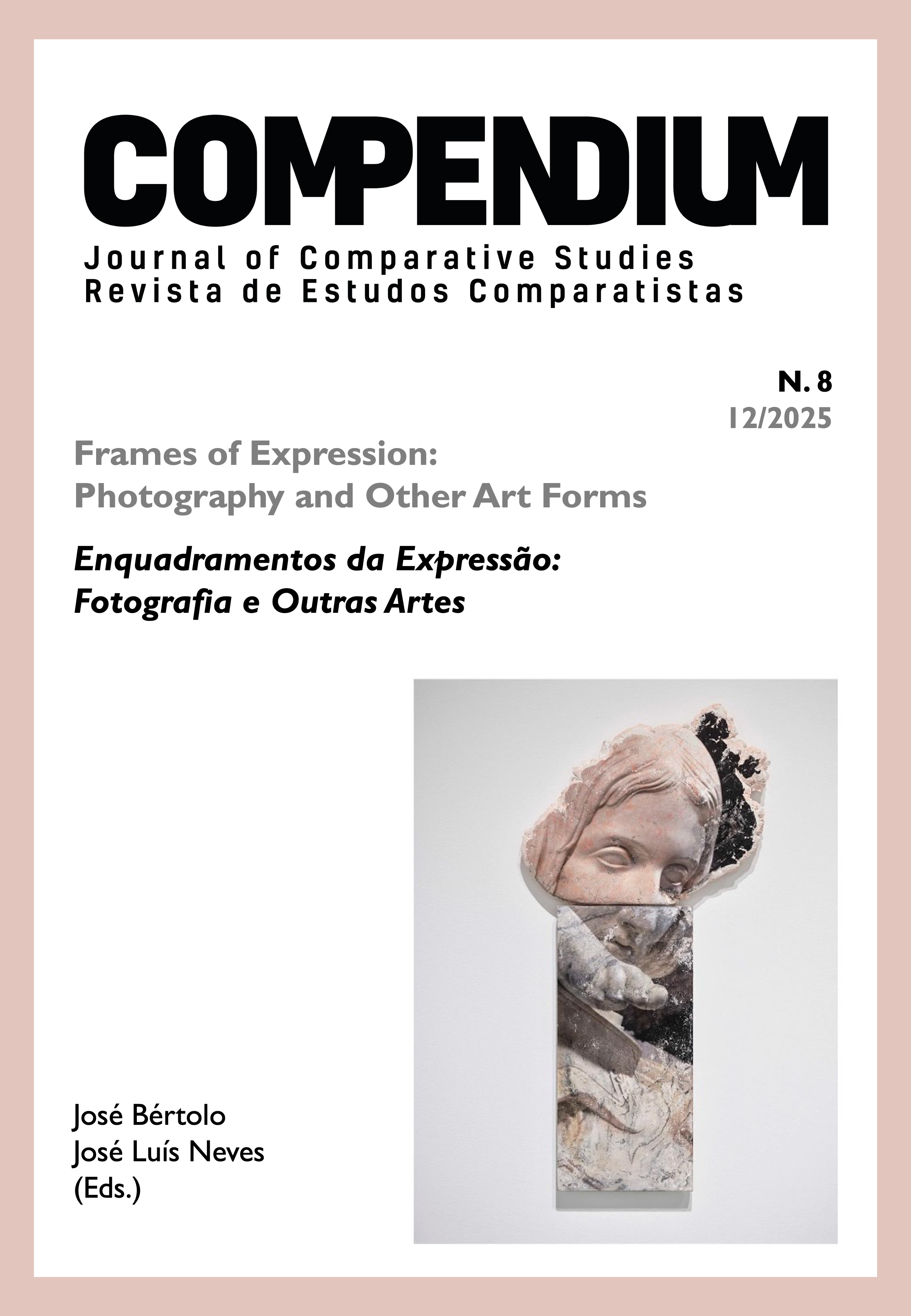
Frames of Expression: Photography and Other Art Forms
Deadline for submission of original articles: 16 June 2025
Publication: December 2025
Guest editors:
José Bértolo (NOVA University of Lisbon, Portugal)
José Luís Neves (Belfast Exposed Gallery, UK)
Photography has always navigated a complex relationship with other arts, straddling the line between mechanical reproduction and artistic expression. This dual nature raises fundamental questions: Can photography be reduced to a mere tool for documenting reality, or does it possess the potential to transcend representation and establish itself as a fully expressive art form? Throughout its history, photography has continuously engaged with other media—painting, literature, performance, and beyond—creating a rich dialogue that not only shapes its evolving identity but also allows it to challenge and expand the boundaries of traditional artistic practices.
One example of this can be seen in the genre of Pictorialism, where late 19th-century photographers adopted painterly techniques to produce images that emulated the compositions, soft-focus effects, and atmospheres of Impressionist and Symbolist paintings. Figures like Alfred Stieglitz and Julia Margaret Cameron experimented with processes and lens modifications to evoke an emotional and interpretive experience akin to painting. This early desire to gain recognition within the realm of fine arts reveals how photography has often sought inspiration from other media while crafting its own aesthetic language.
In the 20th century, artists such as Man Ray and Dora Maar pushed the boundaries of photography through engagement with surrealism and Dada, integrating collage, painting, and mixed-media experimentation to expand the visual language of photography. Other photographers ventured into additional creative fields that enriched their photographic work. Robert Frank, for instance, was not only a groundbreaking photographer but also an influential filmmaker; his documentaries Pull My Daisy and the subversive Cocksucker Blues demonstrate how his raw, spontaneous approach to photography extended seamlessly into film, where he could explore narrative and movement. Patti Smith, renowned musician and poet, also creates powerful photographic work. Her images, often taken with a vintage Polaroid camera, reflect a poetic sensibility, capturing personal, intimate scenes that resonate with themes from her music and writing.
Modern and contemporary photographers continue to innovate on the medium by working across artistic disciplines. Luigi Ghirri, drawing on his background in architecture, used his deep understanding of space and structure to create photographs that blend landscape, architecture, and abstraction, exploring themes of modernity, memory, and perception. Eikoh Hosoe, on the other hand, integrated photography with literature, theater, and dance, producing sensual, symbolic compositions influenced by Japanese folklore and avant-garde performance, particularly in his collaborations with butoh dancer Tatsumi Hijikata and writer Yukio Mishima. Cindy Sherman utilizes theater and performance in her work, staging cinematic portraits of herself as various characters to explore identity and societal norms. Sophie Calle blends photography with literature and conceptual art, often incorporating written narratives or documenting personal experiences, creating intimate, story-driven works that blur the line between autobiography and art.
These interdisciplinary practices demonstrate how photography transcends its role as mere representation by interacting with other art forms. By drawing on diverse artistic traditions, photography’s ongoing relationship with other arts allows it to occupy a dynamic space that challenges fixed categories, emphasizing its role as both document and creative force.
Some of the topics we hope to explore in this issue include:
- Historical and aesthetic intersections between photography and painting, sculpture, or literature: How photography has borrowed techniques from traditional art forms, such as composition or storytelling, and how it has influenced or been influenced by painting, sculpture, and literature over time;
- Photography and performative arts (e.g., dance, theater) and how they create new expressive possibilities: How photography interacts with dance, theater, or performance art, both in capturing performance and incorporating performative elements into the photographic process;
- Photography as storytelling or narrative art: How photographers use their work to tell stories or create narratives, using sequencing, subject matter, or staging to convey meaning beyond mere documentation;
- Photographers who practice in other art forms: How photographers who also practice other art forms (e.g., film, music, literature) bring cross-disciplinary influences to their photographic work, enriching its visual and conceptual depth;
- Photography and digital art: How the intersection of photography and digital art, through digital tools and techniques such as manipulation, collage, and 3D rendering, has expanded the possibilities of photographic practice and its relationship to new media.
We encourage contributions offering theoretical perspectives, close readings of specific works, or comparative studies that reveal photography’s unique position at the intersection of documentation and artistry. Submissions may examine historical or contemporary practices, engage with critical theory, or present interdisciplinary approaches.
Submitted articles may be written in English, Portuguese, Spanish, or French, and should range between 6,000 and 8,000 words, including notes, references, an abstract of 150 to 250 words, as well as 4 to 6 keywords. Authors must follow the formatting guidelines listed in the Submissions section under Author Guidelines on the journal’s website. Submissions must include a separate document containing a short biographical note of the author, up to 100 words, and their ORCiD number.
Online submission: to register and submit your article for peer review, please follow the hyperlink Make a Submission on the Compendium homepage by 16 June 2025.
* Poster image: Liane Lang, “Joan in Fragments”, 2019, Deep Time Dip, Installation View, Butler Gallery. Photo Credit: Ros Kavanagh.


